

For Jazz artist Ziza Muftic, music was never just a hobby. Growing up in Zagreb, Croatia, it was a guiding light that offered safety, structure, and a deep sense of identity.
"It was one of those things that happened organically," Ziza says, reflecting on her early childhood. "For my mom, it was a practical thing of taking us off the street. By the time we were seven, my mom was like, 'Ah, music school.' I've never missed a music class. It was always something that gave me a sense of belonging and purpose."
Her life changed dramatically when her family relocated to South Africa as teenagers, during a period of intense political transition in both countries. Arriving in Johannesburg was overwhelming for the young classical violinist, who did not speak English at the time.
"Joburg intimidated me a lot when we arrived," Ziza admits to Eyewitness News. "I remember standing on top of Carlton Centre, looking at Joburg... and I'm like, 'Nobody knows me. How am I ever going to know you? You are so big.'"
READ MORE:
'I approach music just like prose and poetry,' says songster Internet Athi
Why Gurulogic left a 15-year engineering career for his first love: Music

She struggled initially while starting her studies at the University of the Witwatersrand (Wits), fearing she would fail because of the language barrier.
Beyond the linguistic shift, the suburban lifestyle with its strict security measures felt alien compared to the open-door community culture she left behind in Zagreb. Yet, as she adapted, she found her place in the city's vibrant underground music scene, visiting famous venues like Bassline and Rocky Street.
Although classically trained, Ziza fell naturally into the world of jazz, a genre she had loved since childhood after hearing swing rhythms in cartoons. Over time, she merged her Eastern European roots with her rich heritage of South African jazz, drawing inspiration from local musicians, DJs and singers.
Her 2024 album, Singing in Tongues, highlights this unique blend, featuring tracks sung in Croatian, isiXhosa, isiZulu and English. Ziza discovered that African languages share striking phonetic similarities with Balkan languages.
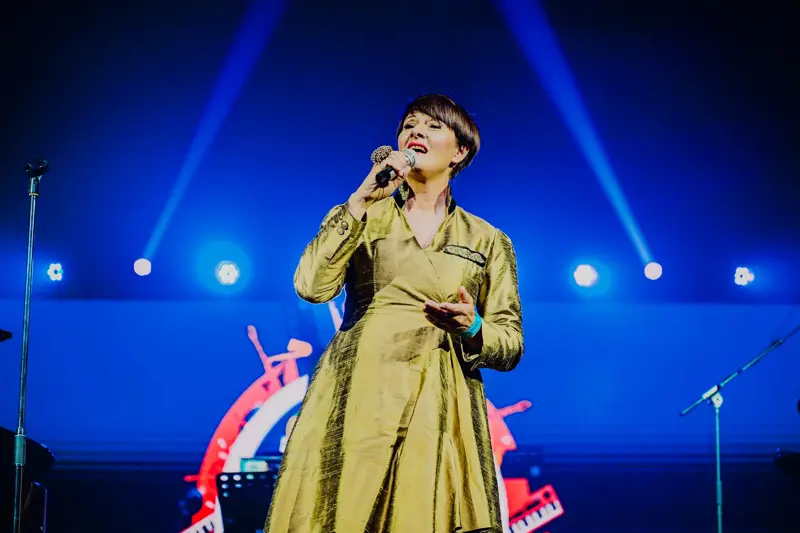
"African languages are ideal for singing because they have clean vowels, just like Italian," she explains. "English, to this day, is hard to sing because it's not clean."
Musically, she found that the intricate polyrhythms, minor scales and complex time signatures of Balkan folk music fit naturally alongside South African styles like Marabi and Kwela. Instead of forcing herself to choose between classical violin, European folk or African Jazz, she learned to embrace all aspects of her musical heritage.
"There was at some stage after I finished my classical music degree...an identity crisis," Ziza recalls. "My teacher just calmly said, 'Everything pours into one place, which is you. Why must you be defined?' Why can't I just be Ziza?"
Today, Ziza Muftic stands as a testament to the power of cultural exchange. From a seven-year-old taking her first lessons in Croatia to a respected jazz vocalist and educator in Johannesburg, her story shows how music can bridge world-sized gaps and create a home anywhere.


