

The Western Cape has once again entered a period of water restrictions after the national government this week imposed precautionary cuts on water allocations following dam levels falling significantly below last year's levels and long-term averages.
While authorities insist this is not a repeat of the “Day Zero” crisis in 2018, residents and businesses are being urged to reduce consumption now to avoid harsher restrictions later.
ALSO READ:
Cape Town water restrictions from 1 Dec: Garden watering, pool rules & higher tariffs
Majodina says Western Cape not in a crisis, but precautionary water restrictions needed
At the peak of its severe drought in early 2018, Cape Town was projected to hit "Day Zero" (the date municipal taps would run dry) on April 12.
The city narrowly averted the crisis through aggressive water-saving measures and returning winter rains.
The recent restrictions follow the Department of Water and Sanitation's annual assessment of the Western Cape Water Supply System (WCWSS), which supplies Cape Town and several surrounding municipalities through six major dams, including Theewaterskloof, Berg River, Voëlvlei, Wemmershoek and the Steenbras dams.
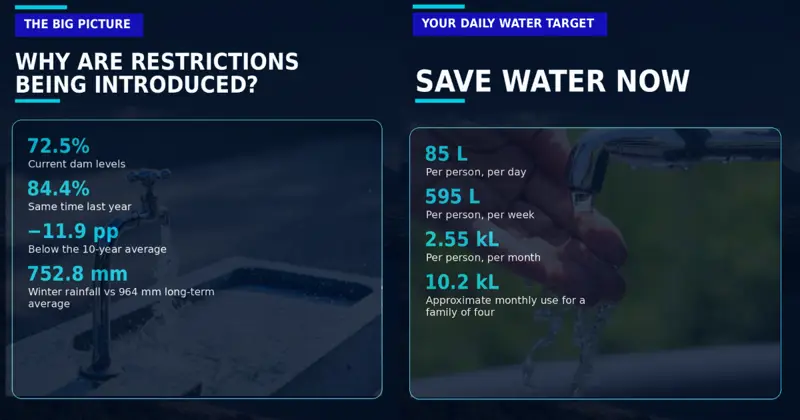
Why restrictions are introduced
Water and Sanitation Minister Pemmy Majodina announced a 7% reduction in domestic and industrial water allocations and a 15% reduction in agricultural irrigation allocations for the 2026/27 hydrological year.
The decision comes after:
- Combined storage in the WCWSS dropped to 72.5% on 2 November 2026.
- This is down from 84.4% a year ago.
- Storage is also 7.5 percentage points below the preferred operational benchmark of 80%.
- Current levels are approximately 11.9 percentage points below the 10-year average.
- Winter rainfall measured 752.8mm, compared with a long-term average of 964mm.
Overall, the government is removing 56.8 million cubic metres of water annually from allocations across the system, an effective 11% curtailment.
Of this, agriculture loses 29.6 million cubic metres per year.
Domestic and industrial users lose 27.2 million cubic metres per year.
Officials have also cited forecasts of a potentially strong El Niño event, which could bring hotter temperatures, increased evaporation and less runoff into dams.
How will Cape Town residents be affected?
The City of Cape Town has confirmed that Level 1 water restrictions will take effect from 1 December 2026.
Residents are being asked to:
Reduce overall consumption by at least 10%.
Limit personal use to approximately 85 litres per person per day.
What does 85 litres per person per day mean?
An allowance of 85 litres per day works out to:
595 litres per person per week
2,550 litres per person per month
About 2.55 kilolitres per month per person
For a typical household:
Household Size Monthly guideline
2 people 5.1kl
3 people 7.65kl
4 people 10.2kl
5 people 12.75kl
This means a family of four that stays within the 85-litre target would use roughly 10.2 kilolitres a month, placing them near the upper limit of the City's second residential tariff block.
New restrictions residents need to know
Under Level 1 restrictions:
Gardens - Municipal drinking water may only be used on Tuesdays and Saturdays.
Watering is limited to one hour.
Watering may only occur before 9am or after 6pm.
Pools - Swimming pools must be covered when not in use to reduce evaporation.
Car washing - Residents must use buckets or high-pressure, low-volume equipment.
Hard surfaces - Hosing down driveways, pavements and other paved areas is prohibited.
Sports fields - Irrigation is restricted to specified days and times.
What will Cape Town residents pay for water?
The City's 2026/27 residential tariffs remain structured according to usage bands.
Higher use attracts significantly higher rates.
Cape Town's tariff schedule contains escalating restriction tariffs for higher restriction levels.
Under Level 1 restrictions, the City can also use pricing to encourage conservation and discourage excessive consumption.
The tariff framework adopted in the City's budget provides progressively more expensive rates as restriction levels intensify.
This means households that continue using large volumes of water become increasingly exposed to substantially higher charges if restrictions are tightened in the coming months.
Not yet Day Zero, but authorities want residents to act now
The government insists the restrictions are precautionary and aimed at preventing a more severe crisis.
However, officials say continuing current consumption patterns would increase the risk of water shortages from 2027 onward.
With the province's major dams sitting at 72.5% capacity, nearly 12 percentage points below the long-term average, authorities say early demand reductions are necessary to protect reserves and avoid a return to the conditions that brought Cape Town dangerously close to Day Zero during the 2017-2018 drought.
Key numbers at a glance
WC water allocation cut: 11%
Domestic and industrial cut: 7%
Agricultural cut: 15%
Dam levels: 72.5%
Last year: 84.4%
Target household reduction: 10%
Daily target use: 85 litres per person
Monthly equivalent: 2.55kl per person
Never miss a major story. Get breaking news and the latest developments from South Africa and beyond as they happen.


