

Despite its economic importance and status as the country’s administrative capital, the metro continues to grapple with coalition instability, infrastructure failures and growing demands for reliable basic services.
Here is a look at the metro and it's historical performance:
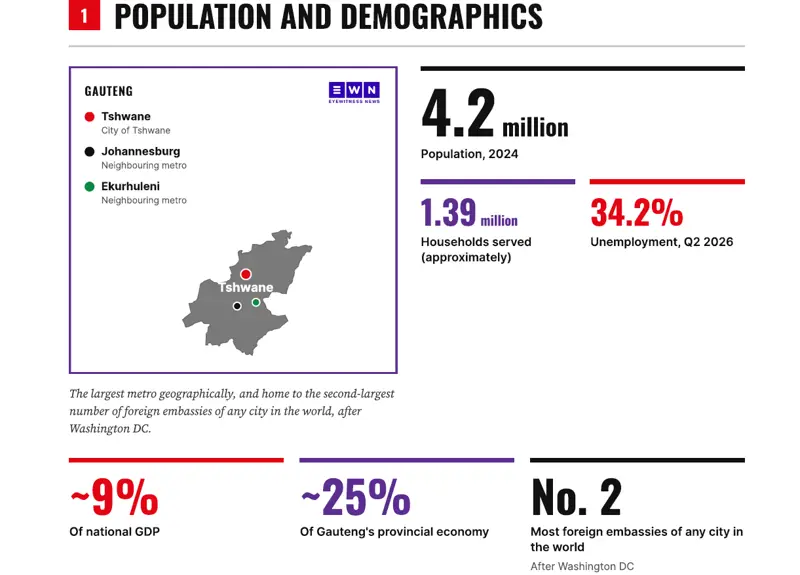
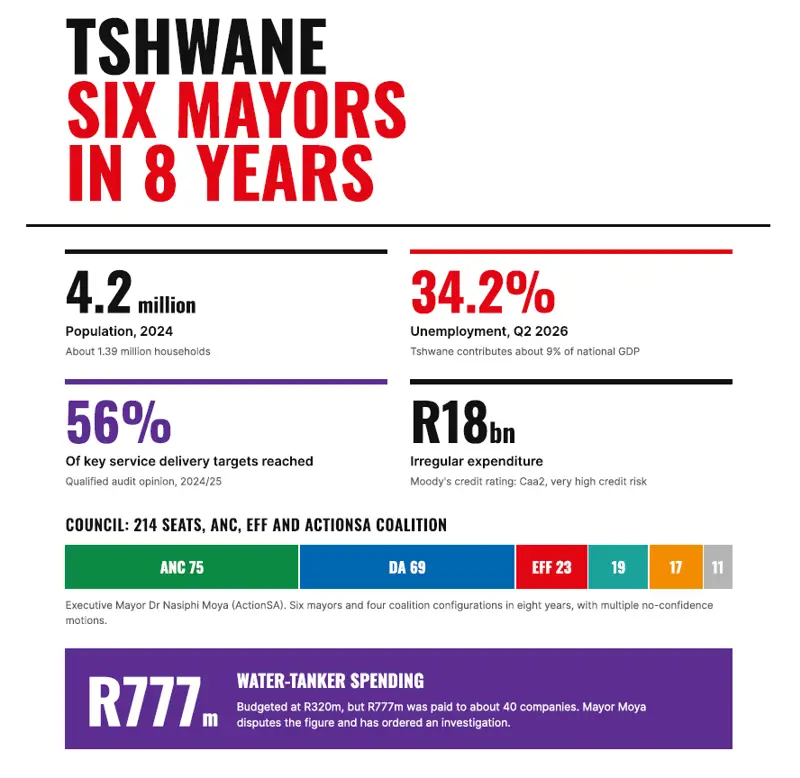
Tshwane is South Africa’s administrative capital and the country’s largest metropolitan municipality by geographical area. With a population of approximately 4.2 million in 2024 and 1.39 million households, it is a major centre for government, advanced manufacturing, research and education.
The metro contributes about 9% of national GDP and 25% of Gauteng’s economy. However, unemployment stood at 34.2% in Q2 2026.
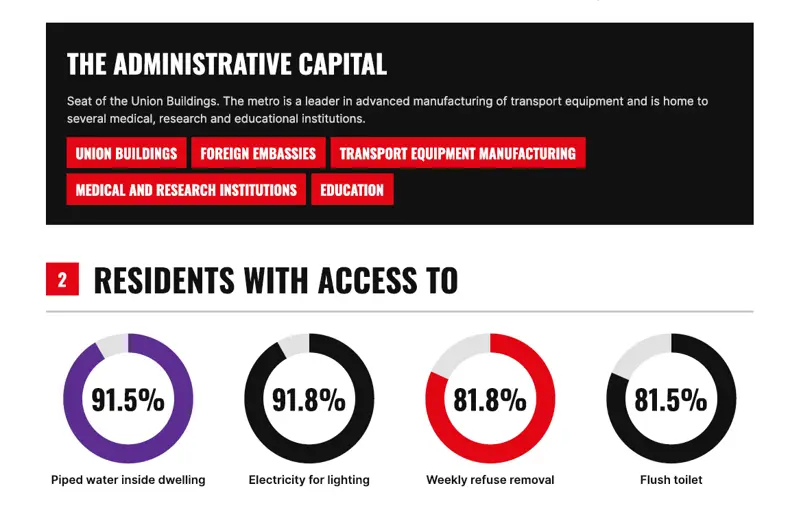
Access to basic services
Most residents have access to electricity and piped water inside their homes, but gaps remain in sanitation and refuse removal.
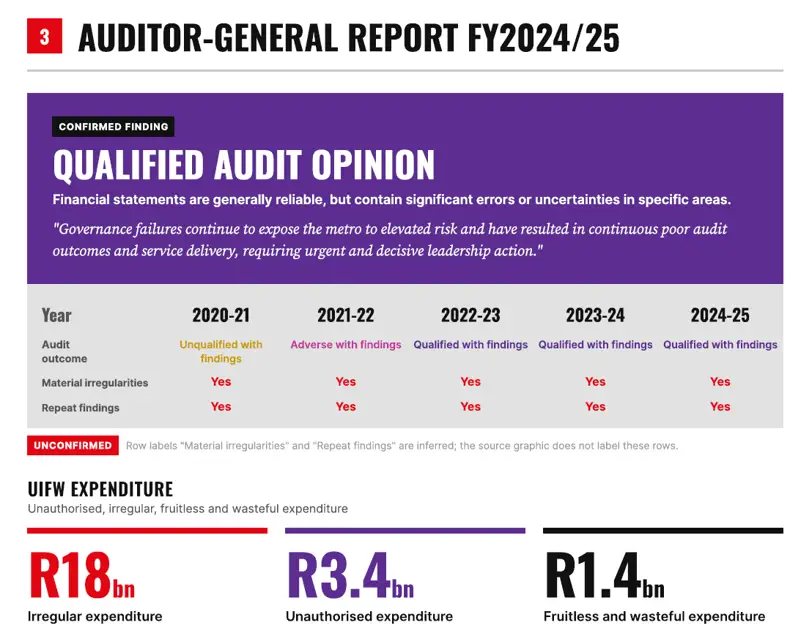
Auditor-General report and financial management
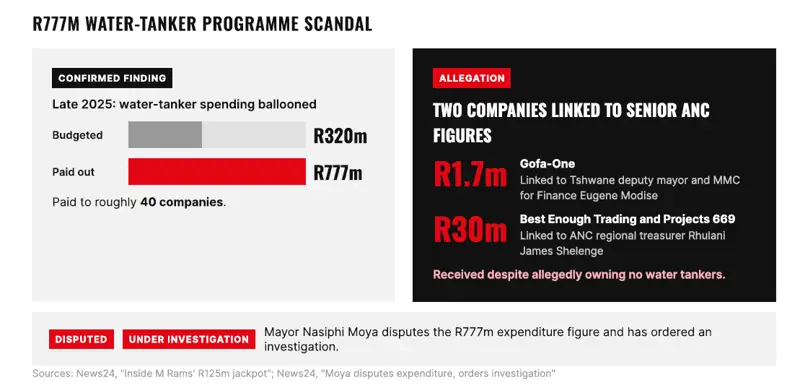
Reported expenditure includes R18 billion in irregular expenditure, R3.4 billion in unauthorised expenditure and R1.4 billion in fruitless and wasteful expenditure.
The metro achieved only 56% of its key service delivery targets. Water and electricity losses were reported at R1.7 billion and R3.2 billion respectively.
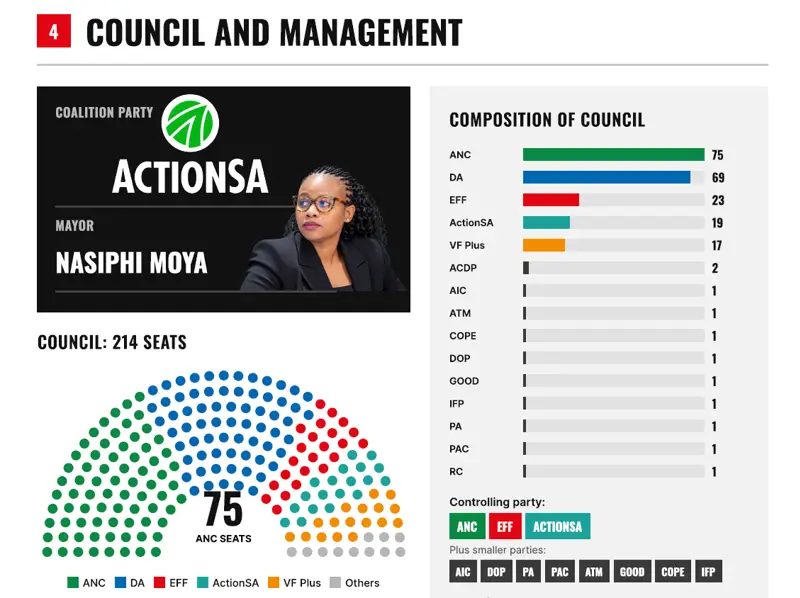
Council and political leadership
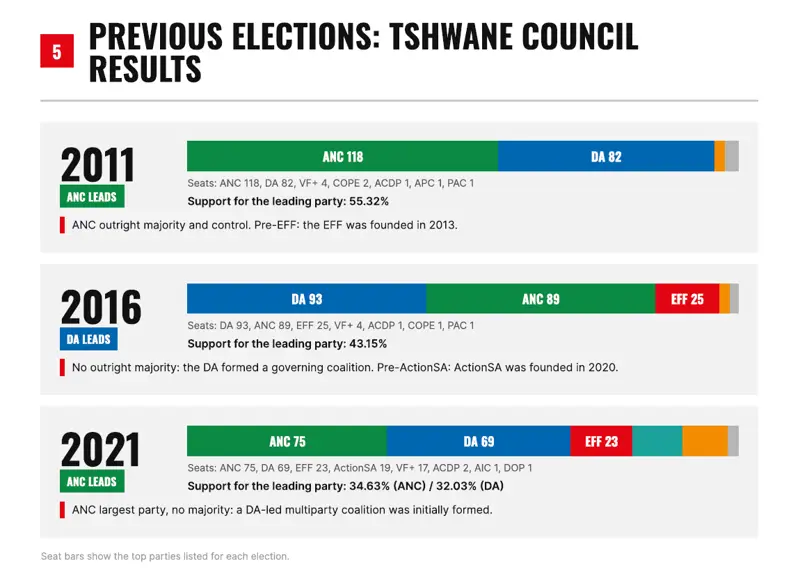
Tshwane’s council is highly fragmented, with the ANC holding 75 seats, the DA 69, the EFF 23 and ActionSA 19, alongside smaller parties. The ANC is the largest party, but no party has an outright majority.
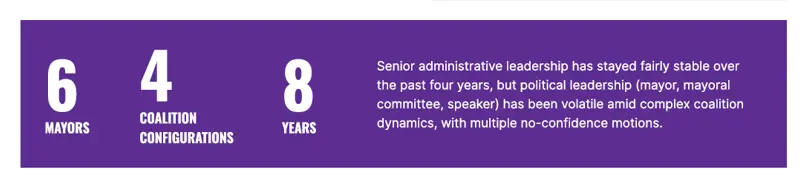
Political instability has been a defining feature of the metro, with six mayors and four coalition configurations in eight years. Frequent leadership changes and motions of no confidence have complicated governance and long-term planning.
Previous election results
Tshwane has shifted from ANC dominance to coalition politics.
- 2011: The ANC won 55.32% of the vote and governed with an outright majority.
- 2016: The DA emerged as the largest party with 43.15%, forming a governing coalition after the ANC lost its majority.
- 2021: The ANC received 34.63% and the DA 32.03%. Neither secured a majority, resulting in another coalition government, initially led by the DA.
Eskom debt
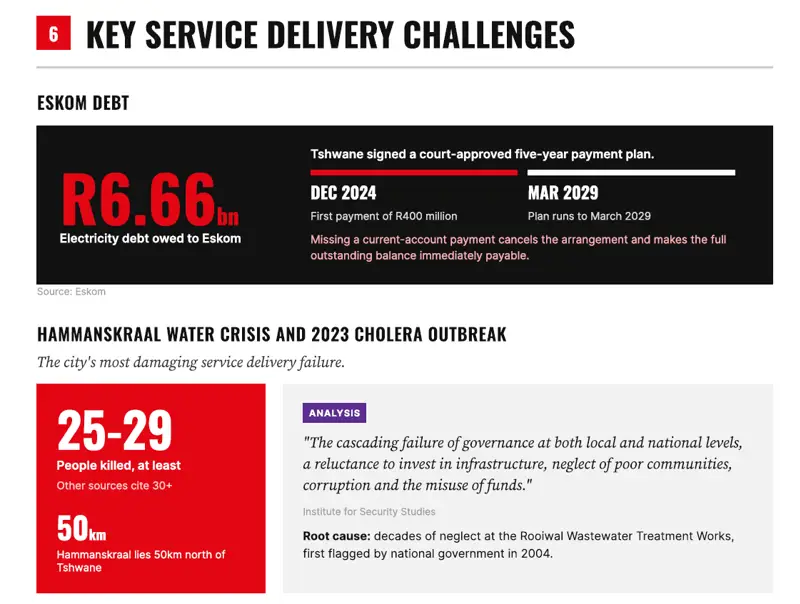
Tshwane signed a court-approved five-year payment arrangement to settle R6.66 billion owed to Eskom.
The agreement began with a R400 million payment in December 2024 and runs until March 2029.
Failure to meet current-account payment obligations could cancel the arrangement and make the full outstanding debt immediately payable, placing further pressure on the metro’s finances.
Hammanskraal water crisis and cholera outbreak
The 2023 cholera outbreak in Hammanskraal exposed years of infrastructure neglect and failures in water governance. At least 25–29 people died, with some reports recording higher figures. The crisis was linked to the long-standing failure of the Rooiwal Wastewater Treatment Works, which allowed untreated sewage to enter the Apies River.
Rehabilitating Rooiwal was estimated to cost approximately R4 billion. A joint project involving the City, the Department of Water and Sanitation and Magalies Water was reported to be making progress in 2026, despite delays.
Informal settlements
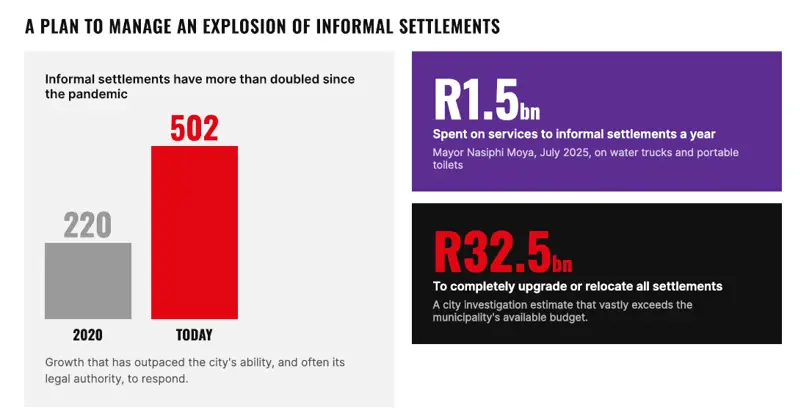
Tshwane’s informal settlements have grown from 220 in 2020 to 502, placing significant pressure on municipal resources. The city estimates that upgrading or relocating all these settlements would cost R32.5 billion, while spending approximately R1.5 billion on services to informal settlements.
Inner-city renewal
Tshwane is pursuing the regeneration of derelict, abandoned and hijacked buildings to improve safety, attract investment and increase access to affordable housing. Thirty-two buildings have been identified for urgent intervention.
The city projects that the programme could unlock 15,000–22,000 residential units. It has also indicated that expropriation may be used where legally justified, particularly where buildings pose public health and safety risks or are unlawfully occupied. The initiative aims to revitalise the CBD and bring more workers closer to employment opportunities.
Safest metro
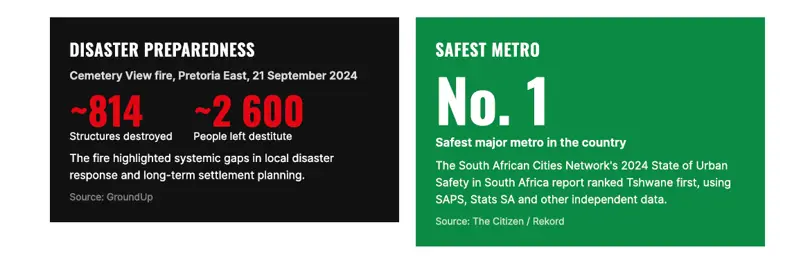
The South African Cities Network’s 2024 State of Urban Safety in South Africa report ranked Tshwane as the safest major metropolitan municipality in the country, drawing on SAPS, Stats SA and other independent data.
This provides a positive counterpoint to the metro’s governance and service delivery challenges, although the ranking does not mean crime and safety concerns have been eliminated.
Tshwane combines significant economic importance and strong institutional advantages with persistent governance, financial and service delivery challenges.
Its key priorities include restoring municipal financial stability, improving water infrastructure, strengthening procurement oversight, managing informal settlement growth and ensuring greater political stability.
Its progress on inner-city renewal, settlement management and disaster preparedness will be important indicators of whether the metro can translate its economic potential into improved living conditions for residents.
ALSO READ: LGE 2026: Get to know some of your Tshwane mayoral candidates
Parliament questions Tshwane metro over Bronkhorstspruit water contamination
Local government elections 2026: Get to know some of your Tshwane mayoral candidates
Video · Brightcove player not connected in this prototype


