

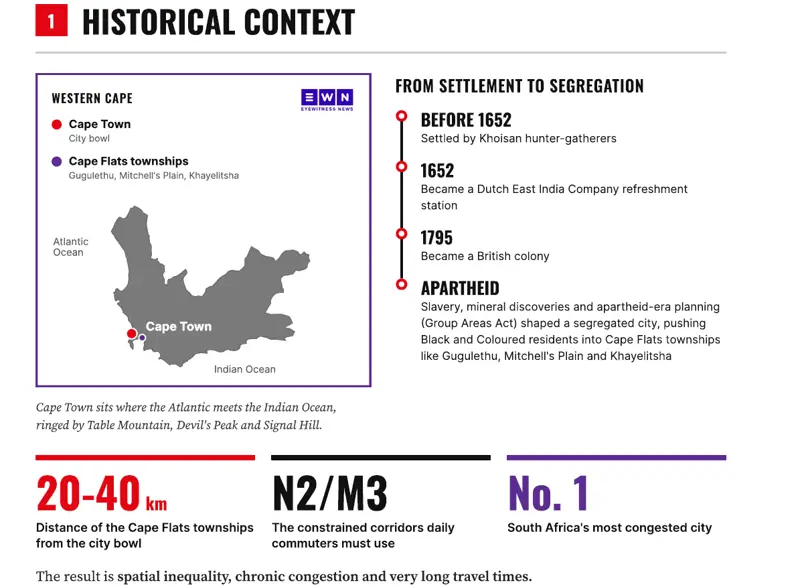
Cape Town is South Africa’s oldest city and legislative capital, with a history shaped by colonialism, slavery and apartheid.
The Group Areas Act forced many Black and Coloured residents into townships and peripheral areas, including Khayelitsha, Gugulethu and Mitchell’s Plain.
These historical settlement patterns continue to drive spatial inequality, long commutes and congestion, with the city now described as South Africa’s most congested.
Here is a look at the metro and it's historical performance:
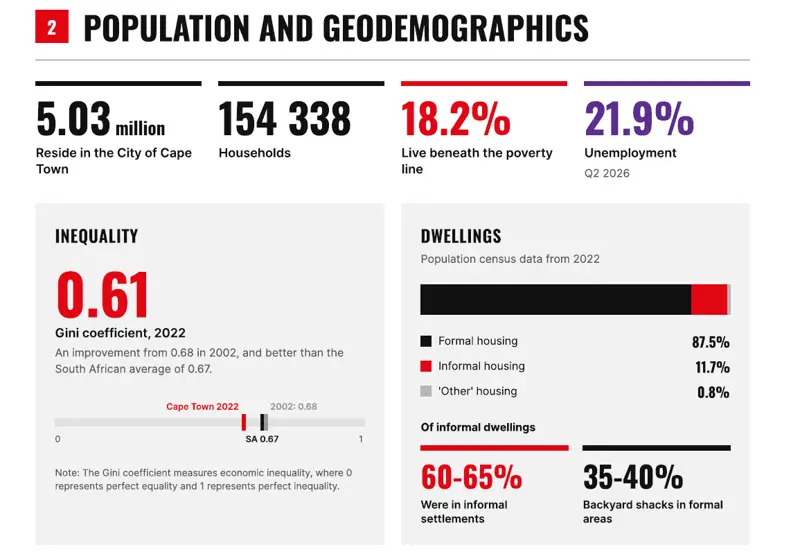
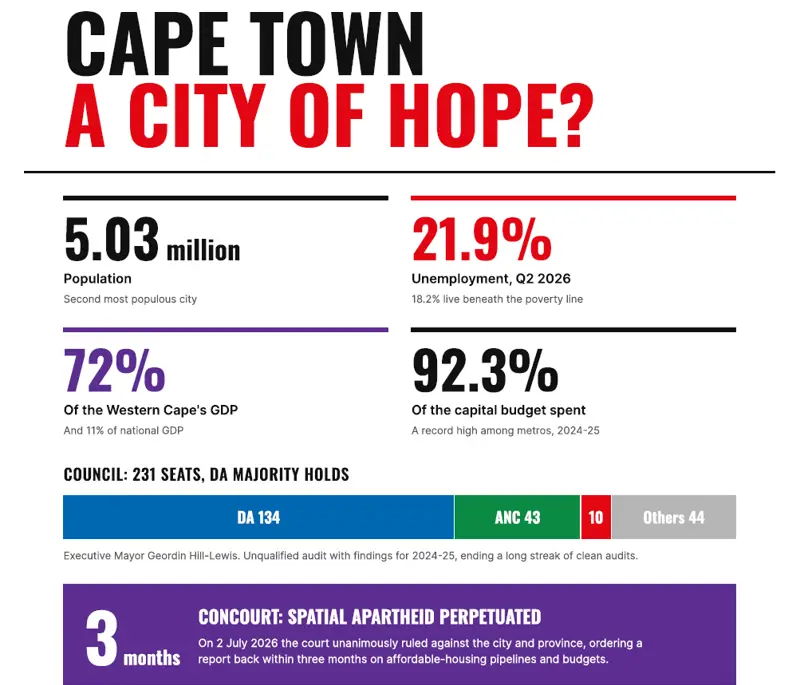
Cape Town has approximately 5.03 million residents and 1.54 million households. About 18.2% of residents live below the poverty line, while unemployment stood at 21.9% in Q2 2026.
Despite its economic strength, the city remains deeply unequal, with a Gini coefficient of 0.61 in 2022, an improvement from 0.68 in 2002.
Access to basic services
Cape Town has expanded access to basic municipal services, particularly piped water inside homes, which increased from 75% of households in 2011 to 85.4% in 2022.
Approximately 91.4% of households have refuse removal and 92.4% have access to sanitation. However, access gaps remain, particularly in poorer communities and informal settlements.
Housing and informal settlements
According to 2022 census data, 87.5% of households live in formal housing, while 11.7% live in informal housing. Of the informal dwellings, an estimated 60–65% are in informal settlements, with the remainder being backyard shacks in formal areas.
Housing affordability, overcrowding and the distance between low-income communities and economic centres remain major challenges.
Spatial inequality
Cape Town’s housing crisis remains closely linked to apartheid-era spatial planning, which left many low-income residents far from employment opportunities.
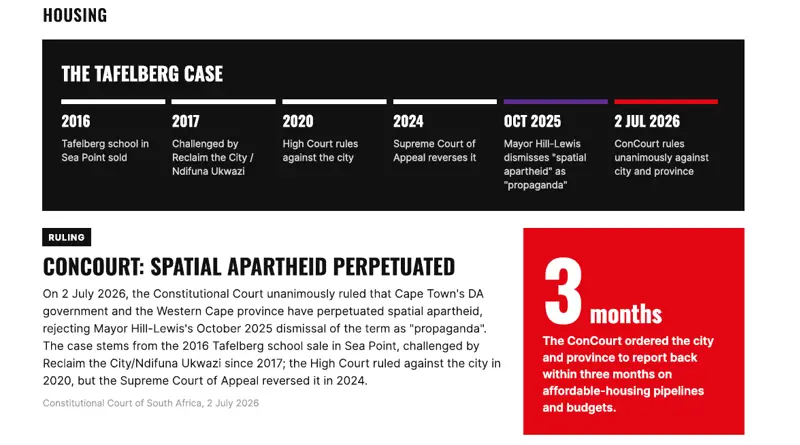
In July 2026, the Constitutional Court ruled in a case concerning the proposed sale of the Tafelberg site in Sea Point, finding that the city and Western Cape government had perpetuated spatial apartheid.
The court ordered the city and province to report on affordable housing plans and budgets. The ruling has renewed focus on the need for affordable housing in well-located areas and the role of government in addressing entrenched spatial inequality.
Economic significance
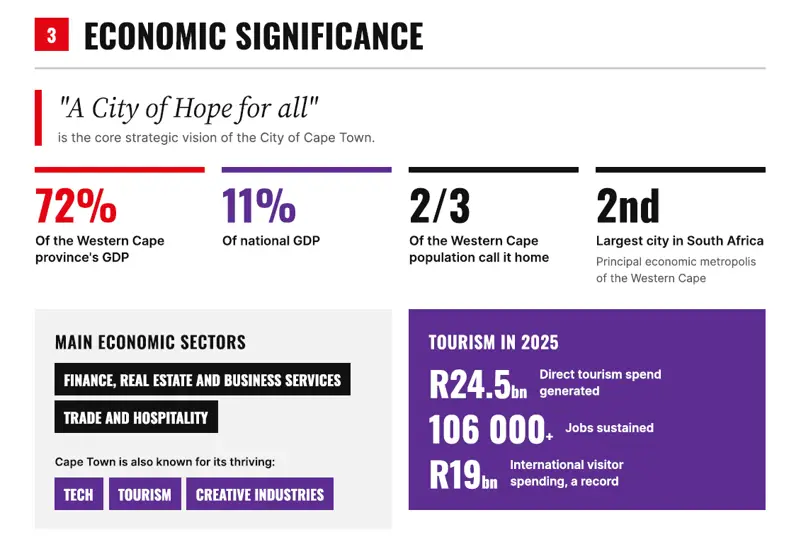
Cape Town is the Western Cape’s main economic hub, generating approximately 72% of the province’s GDP and 11% of South Africa’s GDP.
Finance, real estate, business services, trade, hospitality, technology and creative industries are key economic sectors.
Tourism is also a major contributor, generating R24.5 billion in direct spending and supporting more than 106,000 jobs in 2025.
Council and management
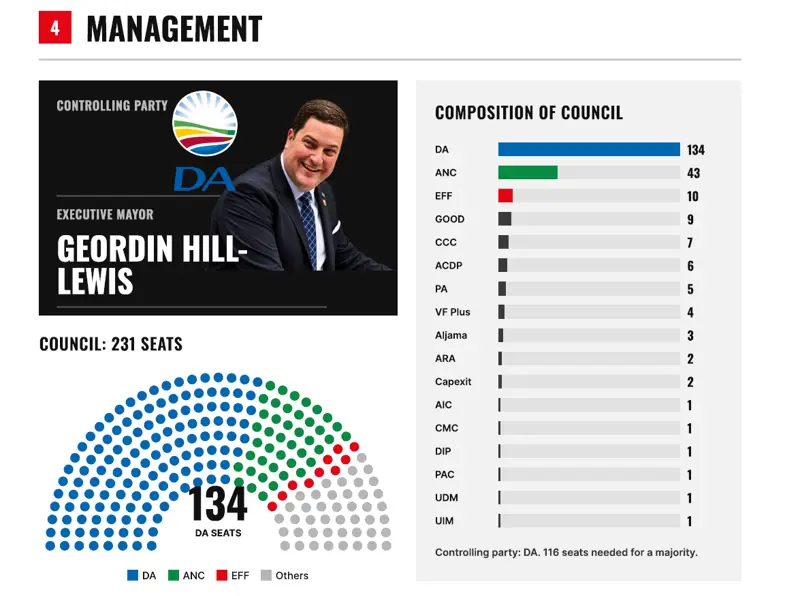
The Democratic Alliance holds 134 seats in the City of Cape Town council and governs the metro under Executive Mayor Geordin Hill-Lewis.
The ANC has 43 seats, followed by the EFF with 10 and GOOD with nine, alongside several smaller parties. Although the DA retains a council majority, the range of parties represented reflects a diverse political landscape.
Auditor-General report for 2024/25
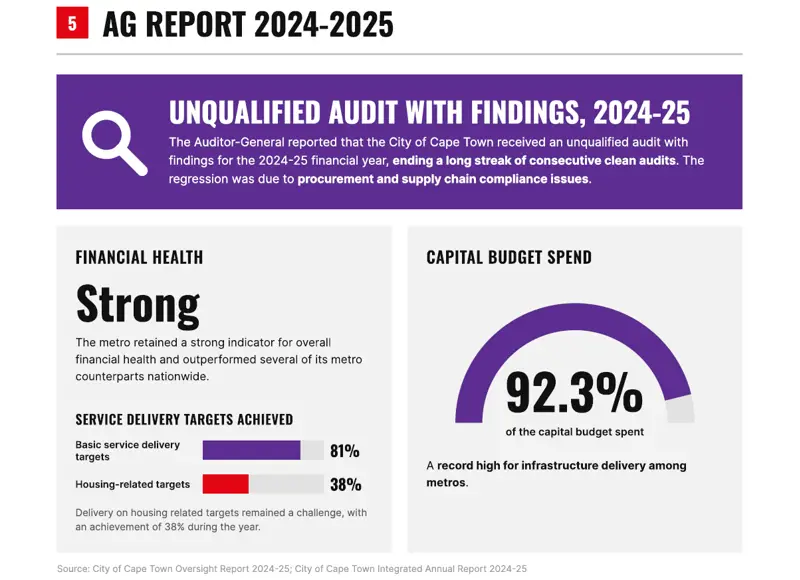
Cape Town received an unqualified audit opinion with findings, ending its long run of consecutive clean audits. The findings related to procurement and supply chain compliance.
Nevertheless, the city maintained relatively strong financial health indicators and spent 92.3% of its capital budget, supporting infrastructure delivery.
It achieved 81% of its reported basic service delivery targets, but only 38% of its housing-related targets.
Previous election results
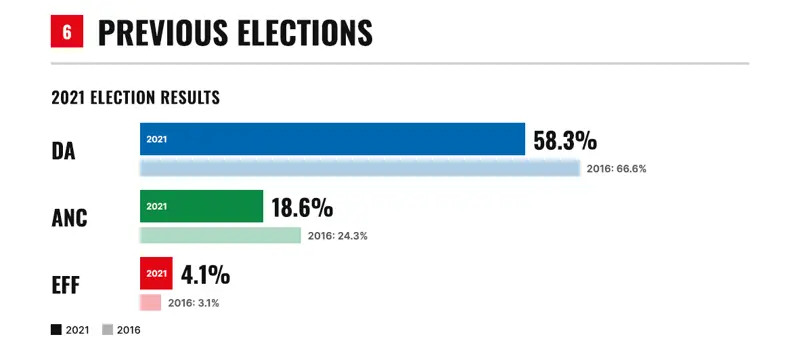
In the 2021 local government elections, the DA won 58.3% of the vote, down from 66.6% in 2016. The ANC’s support fell from 24.3% to 18.6%, while the EFF increased from 3.1% to 4.1%.
The results showed declining support for both historically dominant parties and growing space for smaller political parties.
Voter trends and political dynamics
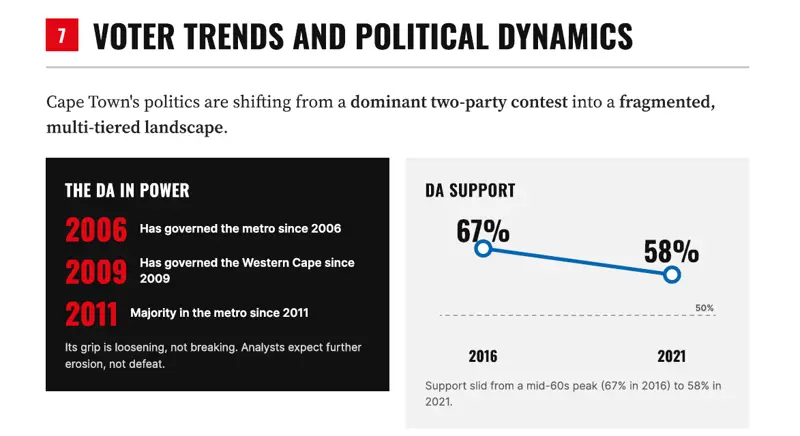
Cape Town’s political landscape is becoming more competitive, with the DA facing pressure from the Patriotic Alliance, particularly in parts of the Cape Flats, and the Freedom Front Plus in some Afrikaans-speaking communities.
The ANC is also seeking to regain support in townships.
Service delivery and municipal spending
Debate continues over whether Cape Town allocates sufficient resources to poorer communities.
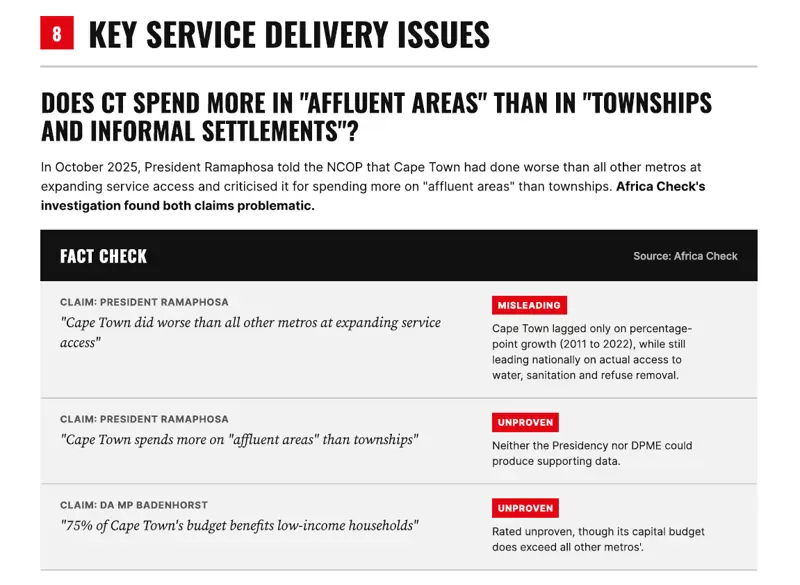
In October 2025, President Cyril Ramaphosa criticised the city’s service delivery record and spending priorities.
An Africa Check investigation found that claims about Cape Town being the worst-performing metro in expanding service access were misleading, while claims that it prioritised affluent areas in its spending were not substantiated by available evidence.
Cape Town is a major economic centre with relatively high access to basic services and strong infrastructure spending.
However, its economic success exists alongside persistent poverty, housing shortages, spatial inequality and unequal service delivery.
Ahead of the local government elections, key issues include the cost of municipal services, affordable housing, conditions in townships and informal settlements, and whether the city can address historical inequalities while sustaining economic growth.
ALSO READ: LGE 2026: Get to know Cape Town mayoral candidates
LGE 2026 | Get to know your Cape Town mayoral candidates
Video · Brightcove player not connected in this prototype


