

June 16 is more than just a date on South Africa’s calendar. It is a reminder of the courage of young people who stood up against injustice in 1976, when pupils in Soweto marched against an oppressive education system and the forced use of Afrikaans as a medium of instruction.
It is also a reminder of the responsibility carried by each generation that followed, to remember, to question, and to continue the work of building a country where young people can live freely and with dignity.
Almost five decades later, Youth Day continues to ask difficult questions.
What does freedom mean for young South Africans today? How do young people understand the sacrifices made before them? And what role do they see themselves playing in shaping the country’s future?
This year, young Eyewitness News journalists reflected on what they would say if they had just one minute to speak to the youth of 1976 in an EWN Youth Day special feature.
Dear Class of ’76: A Letter from Today’s Youth
Video · Brightcove player not connected in this prototype
Their answers moved between gratitude and grief, pride and disappointment, frustration and hope.
Their responses revealed a generation that is deeply aware of the past, honest about the present, and determined to contribute to a better future, even while confronting the difficult realities of unemployment, poverty, inequality, violence, and the slow pace of change.
For many of the young voices at EWN, the first message to the youth of 1976 is one of gratitude. Their sacrifices opened doors that were once deliberately shut to black South Africans, from the right to learn freely, to the right to vote, to the freedom to choose where and how to build a life.
EWN reporter, Anelitha Fandese said if she had a minute to speak to the young people of 1976, she would tell them that their bravery and sacrifice changed what it means to be a young person in South Africa forever.
“Young people today now have rights and access to spaces that may have gone beyond what those pupils imagined when they took to the streets.”
She pointed to the right to vote, the right to education and freedom of speech as some of the most important freedoms enjoyed today.
But for Fandese, those freedoms exist alongside unfinished struggles, pointing out that young people are still battling unemployment, poverty and limited access to opportunities.
“The spirit of the fight lives on among young people in South Africa,” she reflected, offering a message of hope to the generation that marched before her.
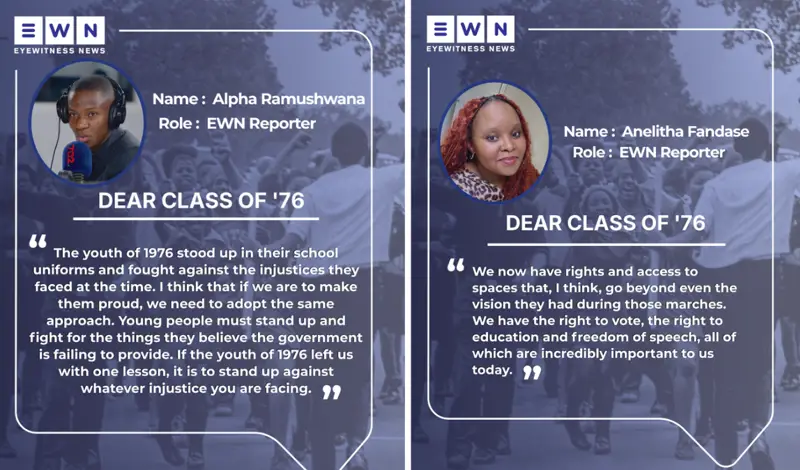
For Alpha Ramushwana, the conversation would also begin with gratitude. He said he would thank the youth of 1976 for their bravery, for marching in school uniform and demanding to be taught in a language that did not rob them of their dignity.
Ramushwana said young people today are living in the fruits of that labour, particularly through the ability to learn in English and in parts of the country, in their mother tongue.
For him, the lesson of 1976 is clear: young people must be brave, but they must also be clear about what they are fighting for.
“If it is unemployment, if we are going to take to the streets as the youth of South Africa, there needs to be a clear agenda,” he said. “We need to be straightforward with what we want.”
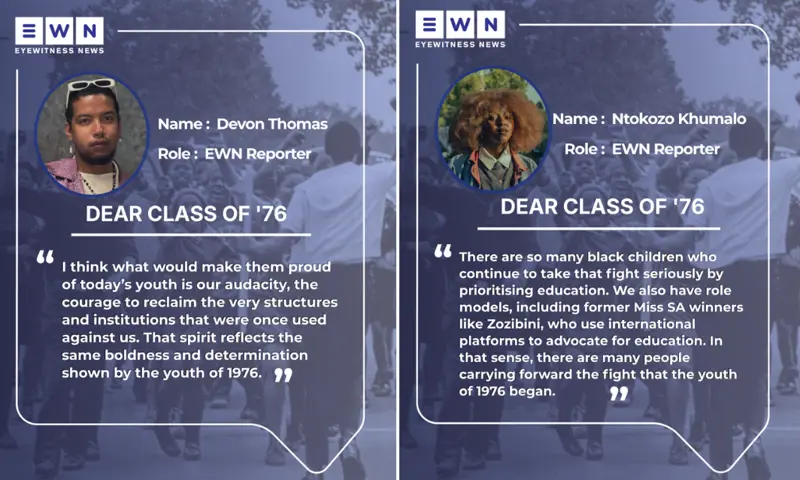
Eyewitness News Online journalist, Devon Thomas said the youth of 1976 should know their efforts were not in vain.
Because of their contribution to a democratic South Africa, he said, he is able to live more authentically and imagine a future with options that were previously denied to many.
“I could do it wherever I want, whenever I want. I could study at any university in the country. And I would not be able to do that without their contribution to leading to a democratic South Africa.”
Thomas described freedom of choice as one of the clearest gains of the struggle. He said young people today, can choose who they want to be, where they want to study, and what language they want to learn in.
He reflected on attending a school that had once been Afrikaans only, but had later become dual medium.
“I actually went to a previously Afrikaans only school and I think because of their advancements and their sacrifices it was turned into like a duo lingual school where you kind of had to choose and like that for me is just a simple example of the freedom of choice now.”
But Thomas noted that there is still work to do, particularly around indigenous languages in schools. While the Bantu education system was abolished, he said Afrikaans continues to play a significant role in many schools, while access to indigenous languages remains uneven.
He also spoke about the gap between rights on paper and lived reality.
As a queer person, Thomas said legal rights do not always translate into safety, belonging or dignity in everyday life. For him, the challenge facing young people today is not only to defend freedom, but to make it real in every space.
His message to the youth of 1976 was simple but determined: “Keep fighting, because eventually we will get there.”
The 1976 uprising was rooted in education, and that remains a recurring theme.
For Ntokozo Khumalo, the freedom to access education is real, but the quality of that education remains a struggle.
Khumalo said the apartheid education system was designed to keep black people inferior and limit what they could become.
Today, she said, black people are present in fields they were once excluded from, and young people now have the possibility of becoming anything they want to be.
“And we still do need more infiltration of black people in these spaces, but these are the freedoms that we have. That we have the possibility now, before we did not even have those possibilities of education. Of being in any field that we want to be in. Of being anything we want to be because of the oppressive system that ensured that we are always inferior to what a white person has.
In regards to knowledge and in regards to wealth generation in knowledge.” She said.
But she stressed that possibility is not the same as justice as young people continue to face unemployment, corruption, poor implementation of policies, gender-based violence, and the lasting effects of systems that were never built for them.
Khumalo said the youth of today are still activists, even if their battles sound different.
Whether fighting against gender-based violence, unemployment, or political apathy, she said young people are not sitting back. They are taking notes from the youth of 1976 and acting on them.
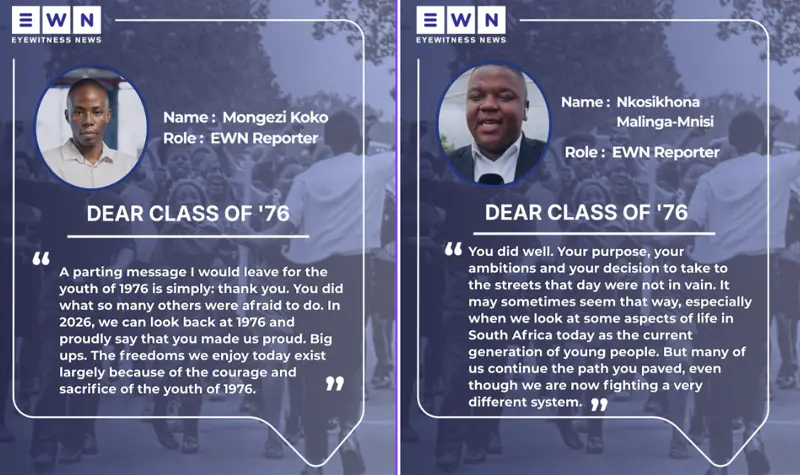
Nkosikhona Malinga-Mnisi also returned to education as both a site of progress and disappointment, saying the youth of 1976 would be proud that young people today can walk freely, enter industries that were once reserved for a select few, and express themselves in their work.
As a broadcaster, Malinga-Mnisi said he believes he is where he is today because someone believed in him and gave him an opportunity.
However, he said many young people are still denied that kind of support through unemployment, lack of mentorship, and limited access to opportunities.
When asked what he thought would disappoint the youth of ’76, he said they would likely be disheartened by the remaining gaps in the education system, including unsafe schools, poor infrastructure, and children still learning in conditions that are not conducive to dignity or success.
“Some of the biggest disappointments I think for me, if I have to put myself in the shoes of the young people of 1976 in that period, would really be firstly the high unemployment rate. It goes without saying, and we speak about it almost on a daily basis because it keeps increasing, it keeps getting worse,” he said.
“And you're seeing its ripple effects because young people are now turning to substance abuse. Some of them, unfortunately, are turning to crime as well because, not primarily, but it has influence because of the lack of opportunities that they are having to contend with.”
One concern did however recur throughout discussions with working youth at EWN: unemployment.
While the youth of 1976 fought for access to education, young people today ask what happens when education does not lead to work, stability, or dignity.
Mongezi Koko also questioned whether the battles fought in 1976 have truly been answered. He pointed to record-high unemployment, financial exclusion from higher education, and young people finding themselves poorer than ever before.
Koko said he would want to ask the youth of 1976 what they hoped to achieve, and whether they would feel that their calls had been heard.
But after those questions, he said, his message would be one of thanks, expressed in several South African languages for doing what many feared to do.
He said the youth of 1976 may also be troubled by divisions within Black and marginalised communities today.
For Koko, questions of Ubuntu, unity, and collective progress remain central to the unfinished work of freedom.
One thing was certain, however: even with their frustrations, the young EWN voices did not speak only from a place of disappointment.
They also spoke of progress, resilience, and the determination of young South Africans who continue to rise despite difficult circumstances.
Malinga-Mnisi said young people from tough backgrounds continue to prove that success is possible. He pointed to pupils from rural areas and child-headed homes who overcome poor service delivery, lack of resources, and personal hardship, yet still excel academically.
His message to the current youth was: “Don’t give up on yourself. Don’t give up on your dreams just yet. It’s possible.”
Koko said the hard work and success of young people at Primedia and Eyewitness News show what is possible when young people are given space to contribute, saying if people worked in harmony, particularly during Youth Month, they could uplift one another and achieve far more.
ALSO READ: EFF's Malema urges youth to emulate 'the 1976 generation' and fight for rights of young people
Youth Month: 50 years on, Soweto uprising legacy still shadows SA
As South Africa marks Youth Day, the reflections from young EWN reporters and staff show that June 16 is not only a commemoration of the past. It is also a mirror held up to the present.
It asks whether the country has honoured the bravery of those who marched in 1976, and whether today’s young people are being given the tools, opportunities, and protection they need to thrive.
The answers are complicated. There is freedom, but also frustration. There is progress, but also poverty. There is choice, but not always access.
There is education, but not always quality. There are rights, but not always safety.
But there is also a generation that remembers, a generation that questions, a generation that continues to fight in its own language, in its own time, and against its own challenges.
And perhaps that is the clearest message to the youth of 1976: the struggle did not end, but neither did the courage.


