
South Africa's economy delivered a mixed performance in April, with stronger export prices and robust mining activity boosting trade earnings, while manufacturing slipped back into contraction.
April data from Statistics South Africa (StatSA) shows the country benefited from higher prices for metal products and key mineral exports, improving its trade position despite weakness in some traditional commodities.
ALSO READ:
Kganyago warns SA economy could come under pressure from rising oil prices
SARB decision to hike interest rates necessary to contain inflation and save growth, says economist
Stats SA's Director of Industry Statistics, Nicolai Claassen, highlighted the biggest drags.
"Six of the ten manufacturing divisions recorded a negative month, with the iron, steel and non-ferrous metal products and machinery division the key drag on momentum. The division weakened by 6% y/y, subtracting 1.4 percentage points from overall growth. Other areas also came under pressure, particularly wood, paper, publishing, printing, which fell by 10%, along with a sharp 11% contraction in the automotive division."
However, rising oil prices, a sharp monthly increase in import costs and ongoing struggles in the manufacturing sector highlight growing risks to the sustainability of these gains as businesses navigate an uncertain global environment.
HIGHER EXPORT PRICES BOOST SA TRADE, RISING OIL COSTS THREATEN GAINS
South Africa earned more from many of its exports while paying less for imports than it did a year ago, improving the country's trade position. South Africa's Export Unit Value Index increased 8.5% year-on-year in April 2026, 0.6% higher than in March. However, the strong export-price gains are being driven more by metals and manufactured products rather than by traditional mining commodities.
The StatsSA print shows that metal products, machinery and equipment were the biggest contributors to the gains, whose export prices rose 22.5% year-on-year, contributing 10.7 percentage points to the overall export price increase.
Export prices for agriculture, however, weakened by 10.8% in April, while iron ore export prices declined 14.4%, but the strength in higher-value manufactured and processed exports outweighed weaknesses in these raw commodity exports.
The Export Unit Value Index measures price movements and not necessarily increases in export or import volumes.
A country can earn more from exports even if volumes stay flat simply because prices are higher.
On the other hand, the Import Unit Value Index fell 3.3% year-on-year, meaning importers are generally paying lower prices than a year ago. The annual decline in import prices was driven mainly by food products and crude oil. Month-on-month, however, import prices rose sharply by 5.2%. This could indicate that some of the relief from lower import prices may be fading, particularly if oil prices continue rising.
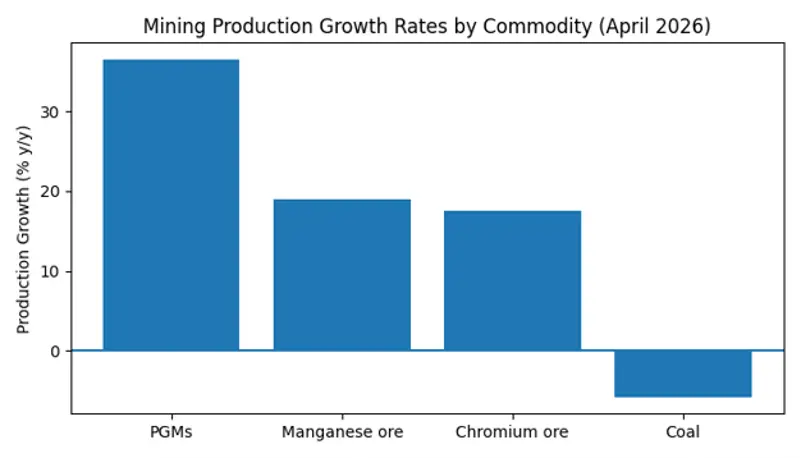
South Africa’s mining sector sustained its growth momentum in April. Output volumes grew by a measured 8.2% year-on-year, while mineral sales surged 30.3% year-on-year over the same period.
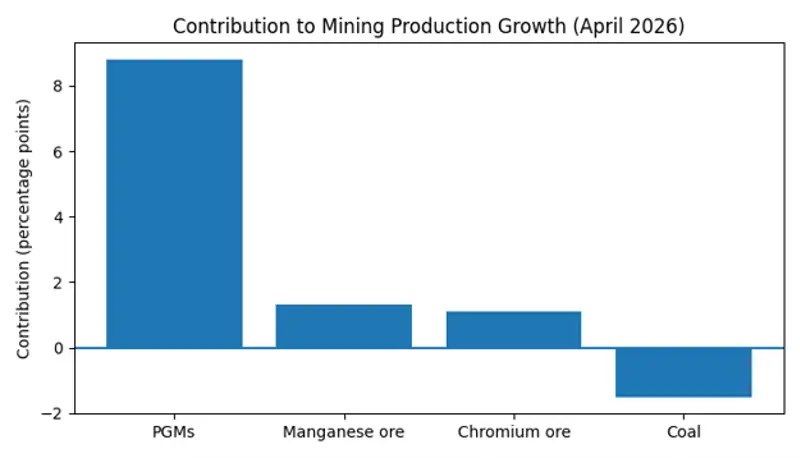
PGMs and gold carried the gains, benefiting from elevated global prices, tight supply conditions and sustained industrial demand. Manganese ore also mirrored these gains, with production rising 19.0% year-on-year and contributing 1.3 percentage points to overall output growth.
The StatsSA data reflects commodity price appreciation that is concentrated in a small number of metals.
Coal production was once again a drag, declining 5.8% and contributing -1. 5 percentage points to the annual production rate, making it the single largest negative contributor.
April 2026 commodity growth rates:
Commodity contributions to annual rate:
MANUFACTURING SLIPS BACK INTO CONTRACTION
As the country took these strides in April, the manufacturing sector weakened with production slumping 2.9% y/y. This follows a brief improvement in March, when production grew 1.5%.
Drags on April 2026 manufacturing production:
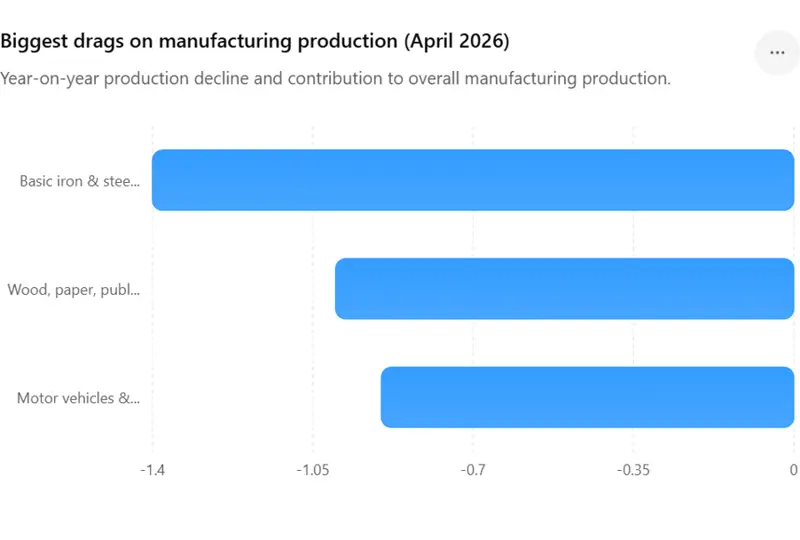
The biggest divisions of the sector are among the top negative contributors to the national manufacturing figure.
The automotive sector, one of South Africa's largest manufacturing employers and exporters, reported an 11% y/y decline in the production of motor vehicles, parts and transport equipment in April, while the production of parts and accessories plunged 22.1%.
The metals segment, one of the largest manufacturing divisions by weight, saw production in the basic iron and steel, metal products and machinery division fall 6.0% y/y, shaving 1.4 percentage points off total manufacturing growth.
Manufacturing production decreased by 1.3% in the three months ended April 2026 (February–April), compared with the previous three months (November–January). Six of the ten manufacturing divisions reported negative growth rates over this period, indicating that weakness is becoming more widespread across the sector.
Despite weaker production, manufacturing sales increased in April. Sales grew 4.7% annually, with the strongest gains coming from the basic iron and steel sector (up 10.4%), followed by petroleum and chemicals (up 5.1%) and food and beverages (up 4.1%)
BUSINESS CONFIDENCE IMPROVES IN MAY
While manufacturing production remained under pressure in April, business sentiment showed signs of improvement heading into the second quarter.
The South African Chamber of Commerce and Industry (SACCI) Business Confidence Index (BCI) rose to 124.1 in May from 123.6 in the prior month.
Higher new vehicle sales and stronger merchandise exports aided the improvement. Rising inflation on the back of oil price shocks remains a concern for businesses going forward.


