
SARB raises rates amid Middle East oil shock
Video · Brightcove player not connected in this prototype
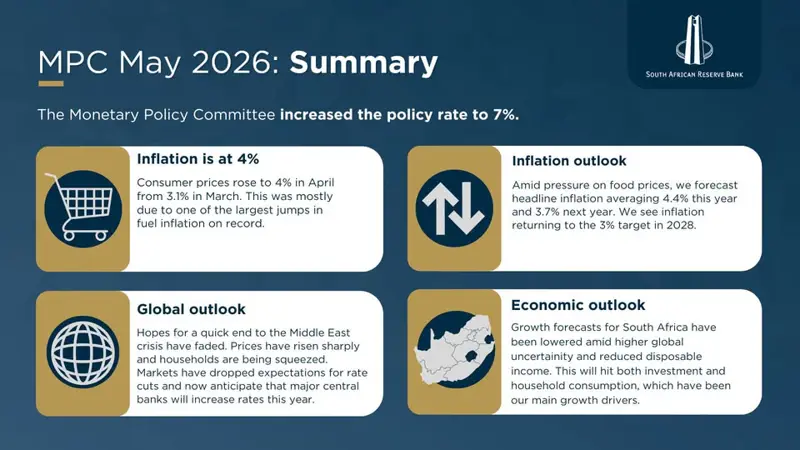
As widely expected, the SA Reserve Bank (SARB) announced it has decided on a rate increase, in the face of the Iran war and the oil price increase and inflationary fears it has led to.
Delivering the Monetary Policy Committee (MPC) statement, Governor Lesetja Kganyago said the benchmark repo rate would go up by 25 basis points, to 7%.
This means the prime lending rate now sits at 10.5%.
The MPC vote was split, with four members voting for the increase and two favouring no change.
Kganyago noted that, since their last meeting, hopes for a quick end to the Middle East crisis have faded.
In this context, oil prices have fluctuated around $100 dollars per barrel, with global growth forecasts being marked down while inflation forecasts have been revised higher.
RELATED: Interest rate hike looms as fuel prices drive inflation to 4%
He said the Reserve Bank has lowered its growth forecasts for South Africa for the next two years.
"Before this shock hit, the economy seemed to be gaining momentum, with the incoming data mostly positive. Now, however, we face a painful combination of higher global uncertainty and reduced disposable income. This will hit both investment and household consumption, which have been our main growth drivers."
The MPC modelled three risk scenarios which include one featuring the El Niño threat, but all of which imply higher inflation and lower growth.
"One is a prolonged Middle East crisis, leading to higher food and oil prices, plus a weaker rand. The second included El Niño, a weather pattern that seems to be forming currently, and which typically brings drought to parts of South Africa. The third scenario added non-linear effects – basically the risk that big shocks have proportionally larger effects on inflation, with more costs passed on to consumers."
Stephen Grootes gets comment from Gina Schoeman, economist at Citi Group South Africa.
Schoeman views the MPC decision as the appropriate one in view of the inflation risks ahead. It is the decision to try and contain inflation to save growth, she says.
"I know no one really enjoys a rate hike because if any debt you have is going to be more expensive, however we'll desperately suffer in South Africa if inflation runs away from us."
"This is given the inflation impact we've already seen, purely from fuel inflation and then also the fertiliser inflation that will hit food later on, but also this potential El Niño threat that is coming at the end of the year."
Looking at the MPC's split vote, she notes that the Governor revealed during the Q & A session that there had been a discussion around a 50 bps hike, even though no one voted for it.
Schoeman adds that the two members who wanted to keep rates unchanged made it clear that this view was about the timing of an increase, and not about direction.
"They still thought they'd need to hike, but maybe at the next meeting. So my read here is that it's still pretty hawkish and that is why we're expecting more hikes from here."
Scroll up to the audio player to listen to Schoeman's analysis
